DABDGE
From record to network
This content is also available as a slide deck
Where we left off
This morning we opened a single record: identifier, content, metadata, provenance. We saw that analyses are joins, and that joins are made of identifiers.
Now the harder half. Records are made by different communities, in different formats, using different words for the same thing, and curated to different standards. This afternoon is about what it takes to put them together, and about what you are entitled to conclude once you have.
How is a biological record structured, made interoperable, and used? We have done structured. Now interoperable and used.
Occurrence data
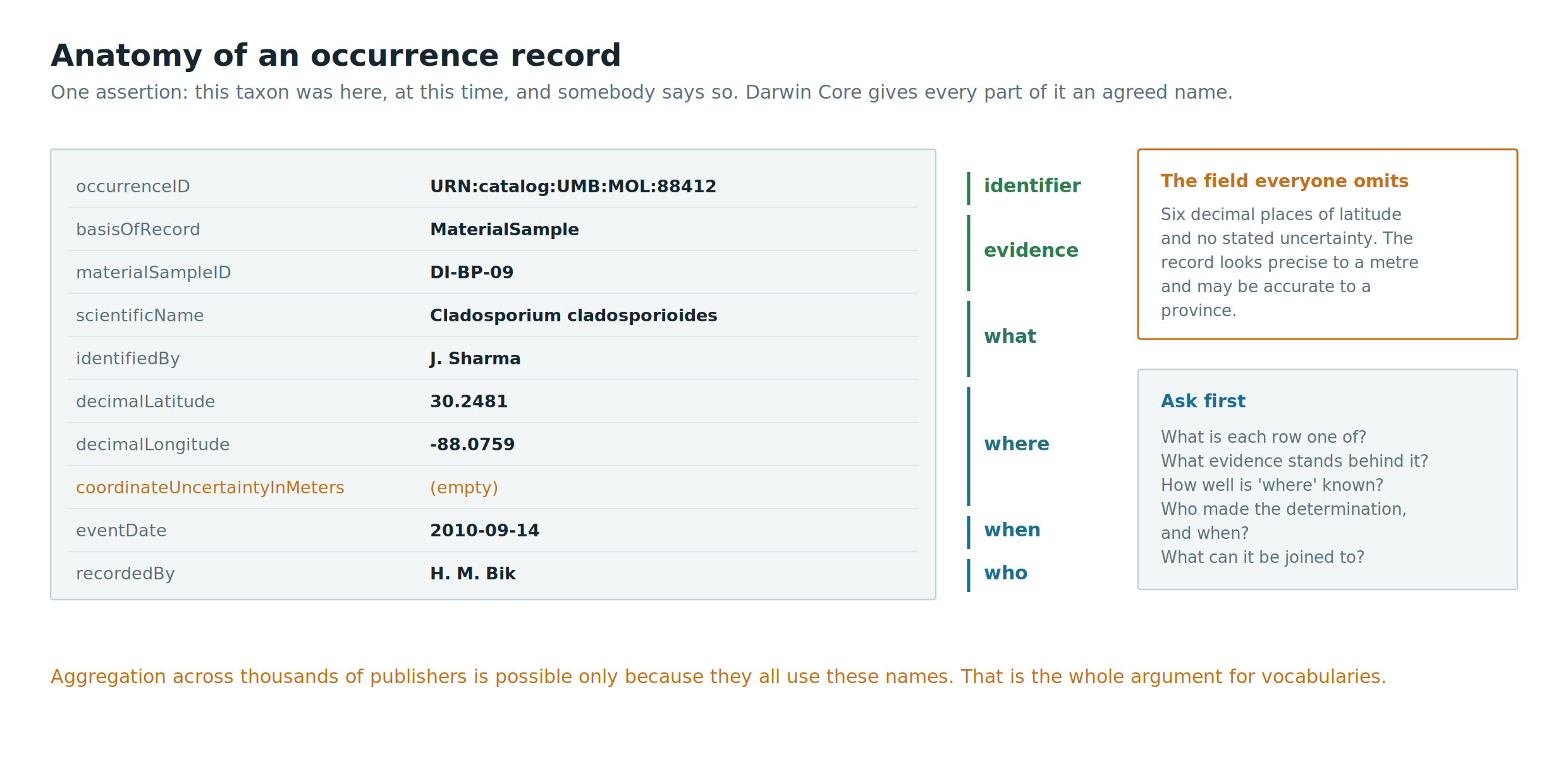
An occurrence is the simplest assertion in biodiversity science: this taxon was here, at this time, and somebody says so.
GBIF aggregates roughly that assertion from museums, herbaria, monitoring programmes, citizen science platforms and sequence-derived datasets. OBIS does the same for marine data. What makes aggregation possible at all is that everyone publishes in the same vocabulary.
Darwin Core
Darwin Core is a set of agreed terms for biodiversity records. Not a file format: a vocabulary, usually delivered as a Darwin Core Archive (a zipped set of tables plus a metadata file describing them).
| Term | What it holds |
|---|---|
occurrenceID |
stable identifier for this occurrence |
basisOfRecord |
specimen, observation, machine observation, material sample |
scientificName |
the name as given |
eventDate |
when, in ISO 8601 |
decimalLatitude, decimalLongitude |
where, in decimal degrees on a stated datum |
coordinateUncertaintyInMeters |
how well “where” is known |
recordedBy, identifiedBy |
who observed, who determined |
materialSampleID |
link to a physical sample |
Two of these deserve attention. basisOfRecord tells you what kind of evidence stands behind the
record, which is the first thing you should ask of any dataset. And
coordinateUncertaintyInMeters is the field that everyone omits, which means that a great many
occurrences with six decimal places of latitude are in fact accurate to a province.
Open a record on GBIF. How many of the terms above are populated? Which absences would stop you from using it?
Where occurrence data come from, and what that does to them
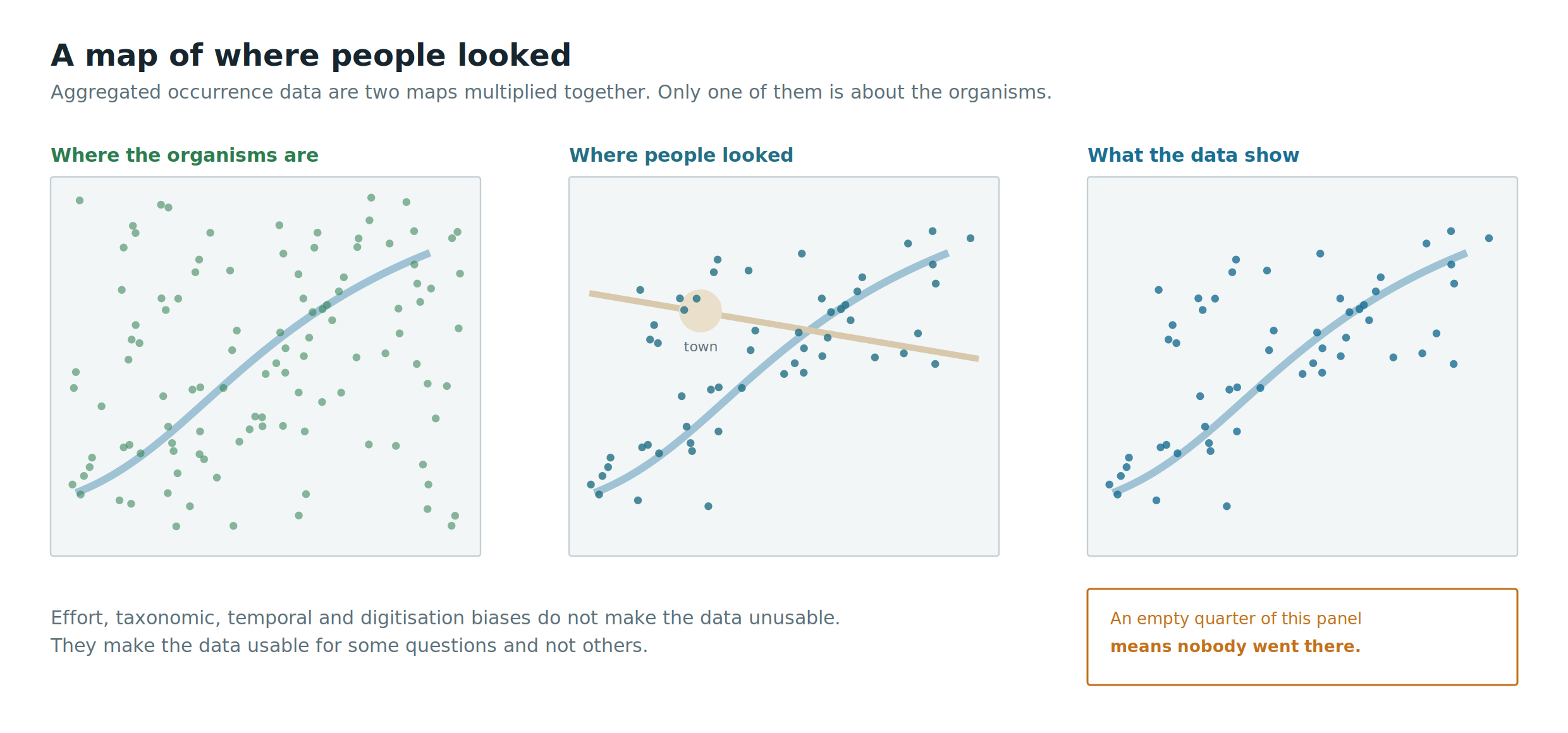
Aggregated occurrence data are a map of where people have looked, overlaid on a map of where organisms are. The two are not the same map.
- Effort bias - roads, universities, reserves, the coast, weekends
- Taxonomic bias - birds and butterflies against nematodes and fungi
- Temporal bias - expedition eras, monitoring programmes starting and stopping
- Digitisation bias - which collections have been databased, and which drawers within them
None of this makes the data unusable. It makes the data usable for some questions and not others. This is the same competence you practised on experimental design last week, applied to data you did not collect.
Programmatic access
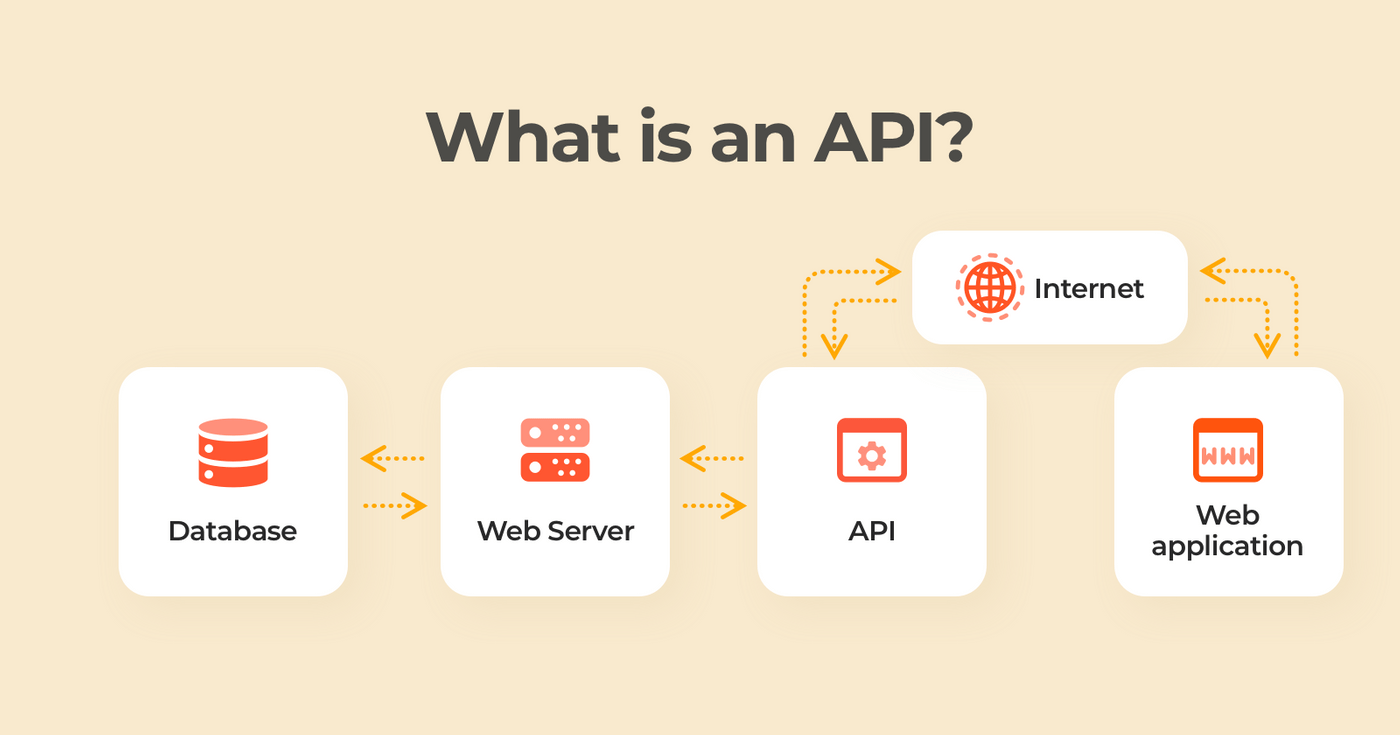
Every resource we discuss today has an API, which means every retrieval you do by clicking can be done reproducibly instead.
# GBIF: occurrences of a genus, as JSON
curl "https://api.gbif.org/v1/occurrence/search?q=Cladosporium&limit=20"

# UniProt: one protein entry, as plain text
curl "https://rest.uniprot.org/uniprotkb/P12345.txt"

# NCBI: one nucleotide record, as GenBank
curl "https://eutils.ncbi.nlm.nih.gov/entrez/eutils/efetch.fcgi?db=nuccore&id=GU706282&rettype=gb&retmode=text"
A retrieval you can paste into a methods section is a retrieval somebody else can repeat. A sequence of clicks is not.
Which of your last five “I downloaded the data from X” moments could you reconstruct exactly today?
BOLD: three record types in one
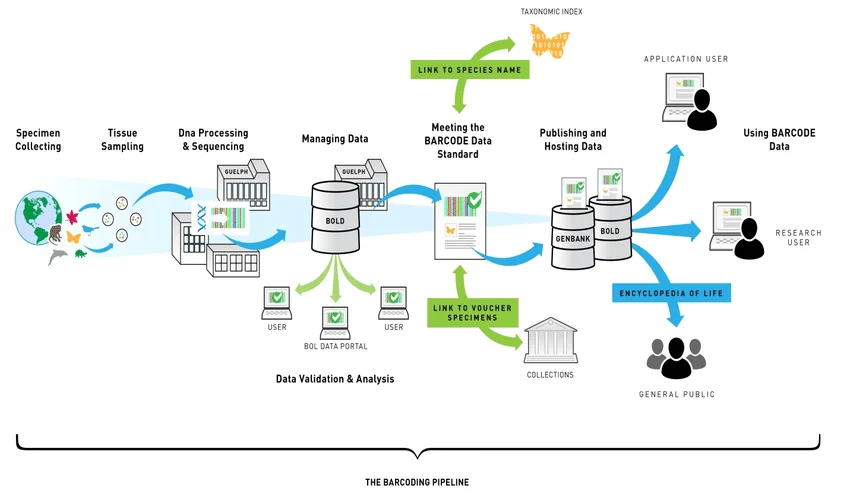
BOLD is worth looking at structurally, because a single BOLD record binds together things that live in separate databases everywhere else:
- specimen data: voucher, collector, locality, coordinates, images
- taxonomy: the identification, and who made it
- genetic data: sequences, the marker, the primers, the trace files
library(BOLDconnectR)

# public ids from BOLD v5
bold_ids <- bold.public.search(taxonomy = list("Danaus"))
head(bold_ids)

# full BCDM records for selected ids (with API key configured via bold.apikey())
bold <- bold.fetch(get_by = "processid",
                   identifiers = head(bold_ids$processid, 200))
head(dplyr::select(bold, processid, marker_code, insdc_acs, genus, species))
In BOLD v5, raw downloads are in BCDM tables (JSON/TSV), not FASTA. For the FASTA defline exercise in TP2.1 we therefore use an archived v3-era file as a teaching artefact:
grep '>' Danaus.fas | cut -f 3 -d '|' | sort | uniq
That tells you which markers are present. It also breaks as soon as you need the sequences themselves, because FASTA records span an unpredictable number of lines. Tomorrow morning you will reach for Biopython at exactly that point.
Scope note. We are looking at BOLD’s structure and retrieval plumbing only (now through BOLDconnectR on the v5 API). Its content, the BIN concept, curation with BAGS and the analysis tools are Filipe’s territory in week 4, and they are the substance of your final integrative report.
A name is not an identifier
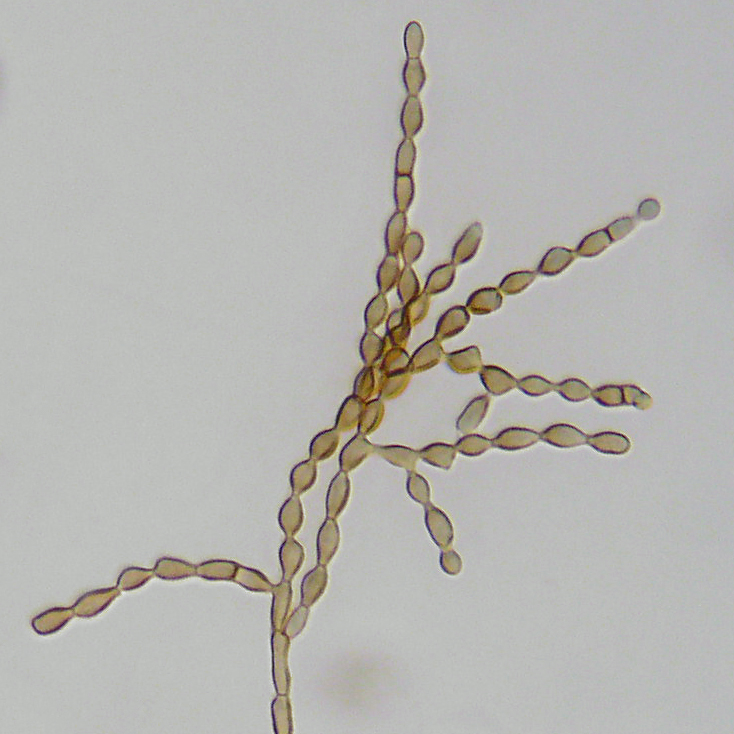
Cladosporium cladosporioides is a hypothesis, expressed in Latin, that may have been revised twice
since the record was written.
- The same organism appears under different names in different datasets (synonyms)
- The same name refers to different organisms in different groups (homonyms)
- Spelling, authorship and rank conventions vary
- Taxonomies disagree with each other, legitimately
So a join on scientificName is not a join. It is a guess that happens to work most of the time,
which is the worst property a join can have.
Reconciliation services
| Service | Scope |
|---|---|
| GBIF Backbone Taxonomy | everything GBIF indexes, with usage keys |
| WoRMS | marine taxa, with AphiaIDs |
| NCBI Taxonomy | taxa with sequence data, with taxids |
| ChecklistBank / COL | published checklists, compared |
| GlobalNames | name parsing and resolution across sources |
Each mints its own identifiers, so reconciliation means mapping between identifier spaces, not “correcting” names. And the disagreements are informative: a fungal genus that resolves cleanly in NCBI and not at all in WoRMS is telling you something true about what WoRMS is for.
The ontology problem
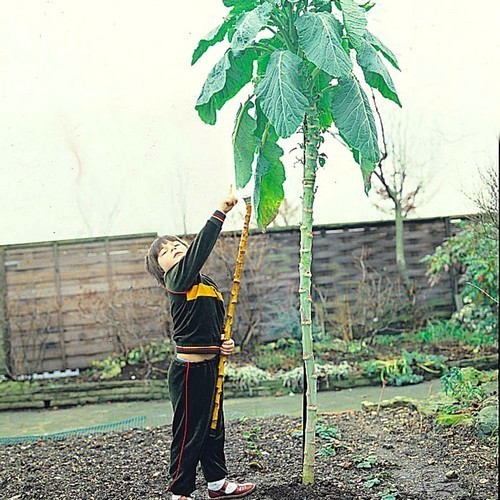
Now the same problem one level up, for the things you measured rather than the organisms.
When does a plant flower? Four trait databases, four field names:
plant flowering beginage_first_floweringBloom_Period- and a fourth that records something adjacent but not identical
These look mergeable. Two questions say otherwise. Do they mean the same thing, given that “flowering” can mean first bud, first open flower or peak? And are the units the same, given that one source may be recording dates and another an age in days?
If you cannot answer those two questions from the documentation, you cannot merge the columns. You can only appear to.
What an ontology is
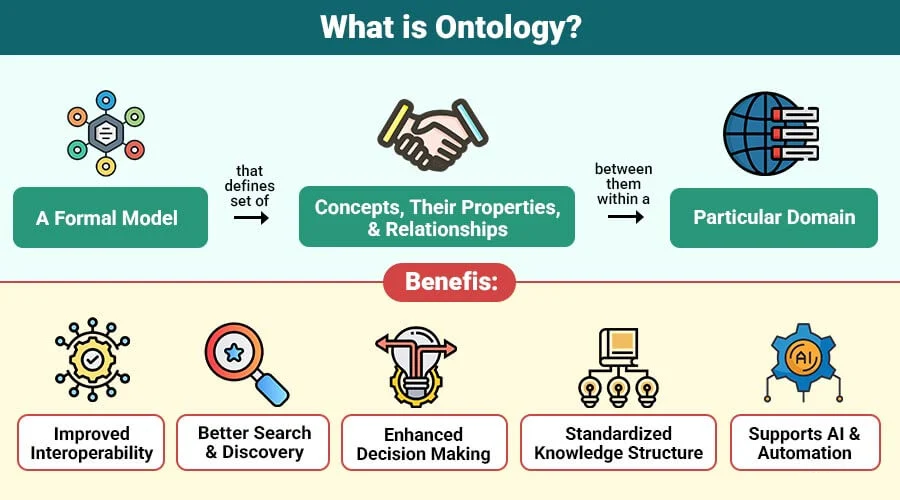
An ontology is a formal naming of the types, properties and relationships in a domain: terms with stable identifiers, written definitions, and explicit relations between them.
Three that you will meet constantly:
- Gene Ontology (GO) - what gene products do, where and as part of what
- ENVO - environments and environmental
materials; the vocabulary behind the MIxS fields
env_broad_scale,env_local_scaleandenv_medium - Darwin Core - strictly a vocabulary rather than an ontology, but the same role
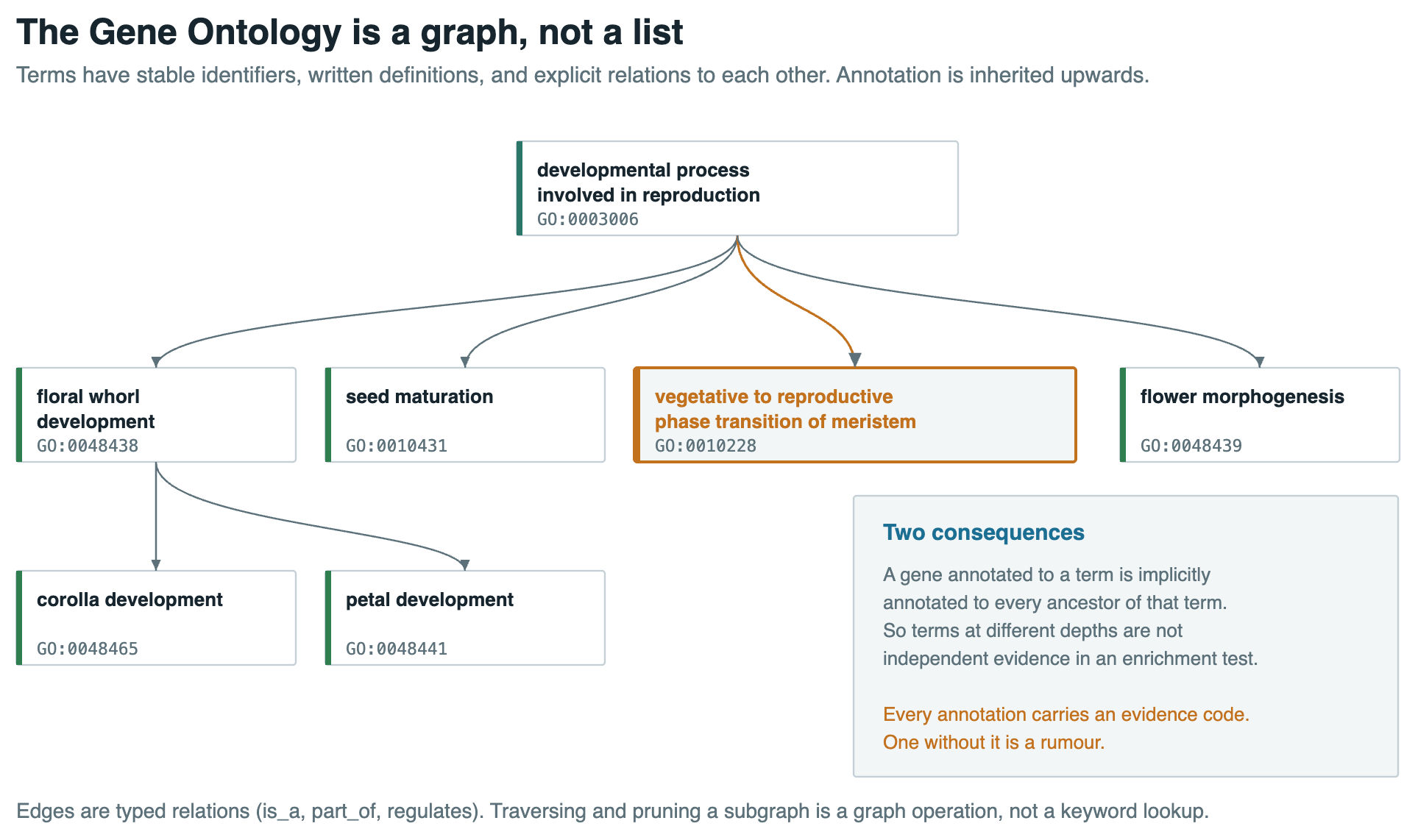
The identifier is the point. GO:0010228 does not drift when someone rewords the label.
GO is a graph, not a list
GO has three aspects, and they are not interchangeable:
- Biological Process - the larger objective a gene product contributes to
- Molecular Function - the activity itself
- Cellular Component - where it happens
And the terms form a directed acyclic graph, related by is_a, part_of and regulates. So a gene
annotated to a specific term is implicitly annotated to every ancestor of that term. Traversing and
pruning subgraphs is therefore a graph operation, not a keyword lookup, and annotations at different
depths are not independent evidence.
Each annotation also carries an evidence code recording how it was made: experimental, inferred from sequence similarity, or inferred electronically without curator review. An annotation without its evidence code is a rumour.
Ontology as an inference instrument
Everything so far has framed annotation defensively: get it right or your merge fails. Here is the other case.
In a study of flowering time in a giant woody kale, a bulk segregant analysis produced tens of thousands of candidate genes inside the inferred QTLs, most of them irrelevant. Selecting only the genes annotated with terms inside the relevant GO subgraphs reduced that by two orders of magnitude. A pathway enrichment test on what remained pointed at the circadian rhythm pathway, and the genes driving it were ones already known to regulate flowering, plus one that had not previously been implicated in this species.
The annotation layer was not documentation of the result. It was the instrument that produced it.
(RA Vos et al., 2022. Refining bulk segregant analyses: ontology-mediated discovery of flowering time genes in Brassica oleracea. Plant Methods 18: 92. doi:10.1186/s13007-022-00921-y)
What that rests on
The annotations in question were not determined experimentally in kale. They were transferred by homology from Arabidopsis.
Which is exactly the structure of taxonomic assignment in a metabarcoding study: an OTU is labelled by similarity to a reference database, above some threshold, and everything downstream inherits that label.
- Similarity to a known thing is used to assign function or identity
- The assignment is only as good as the reference and the threshold
- Everything downstream inherits the assignment, usually without a trace of the uncertainty
Alignment gives similarity, similarity is used to infer function or identity. Pedro opens week 3 with that chain; you are meeting it a week early from the annotation side. Both times, the reference frame is the thing to interrogate.
FAIR, in depth
Findable, Accessible, Interoperable, Reusable. Published in 2016 and now attached to most funding conditions you will ever meet.
| Principle | What it actually demands |
|---|---|
| Findable | a persistent identifier, rich metadata, indexed somewhere searchable |
| Accessible | retrievable by that identifier over an open protocol; metadata survive even if the data cannot be shared |
| Interoperable | standard formats and shared vocabularies, with qualified links to other records |
| Reusable | an explicit licence, detailed provenance, and community standards met |
Note the asymmetry. Findable and Accessible are largely solved by infrastructure: deposit somewhere respectable and you get a DOI and a download button. Interoperable and Reusable require decisions by the depositor that nobody can make on their behalf.
FAIR is not open, either. A record can be fully FAIR and access-controlled, as long as the conditions are machine-readable and the metadata are public.
A live audit
Back to this morning’s introduction. The Gulf of Mexico study deposited in three places. Let us score one of them against the four principles together, live.
Things to look for on the landing page:
- Does the DOI resolve? Are the metadata rich, or the minimum the repository required?
- Can you download without asking anyone? How large is the deposit, and in how many files?
- Is there a manifest, a README, a data dictionary? Are the file formats open?
- Is there an explicit licence? Is there any machine-readable link to the other two deposits?
Score it F, A, I, R, each as pass, partial or fail, and be ready to defend the call. Then ask the harder question: by the standards of 2012, was anything done wrong here?
The answer to that last question is mostly no, and that is the point. FAIR is a moving target that a community agrees on, not a personal failing.
FAIR is a gradient
You will be asked to make your own deposits soon enough, in the project and the dissertation. Three practical rules that get you most of the way:
- Deposit the inputs, not just the outputs. Results are re-derivable from data; data are not re-derivable from results.
- Write the README you wish you had found. What each file is, what each column means, what the units are, what the identifiers point at.
- Say what the licence is. An unlicensed deposit is legally unusable, however open it looks.
Provenance and versioning
Data and analyses both change. The question is whether the change is recorded.
- Version control (
git) records who changed what, when, and why, at the level of lines - A repository plus a DOI records the state of a deposit at a moment
- A workflow, a container or an environment file records what the code was run with
Reproducibility is a competence, not a virtue, and it is practised rather than intended. Tomorrow afternoon you will package your own work so that its files, provenance and environment are clear to someone else, which is the smallest possible version of all three.
Multi-source integration
A worked example of the whole chain. Suppose you want to know whether products on sale contain material from species listed under CITES.
- Metabarcode the product to get sequences
- Identify those sequences against a reference database
- Join the resulting names to the CITES appendices
- Conclude something about compliance
Every join in that chain is a place where the argument can fail: the reference database may lack the species, the names in the appendices may be synonyms of the names in the database, and the detection of a sequence is not the detection of a listed part of a listed organism.
The biological finding and the regulatory claim are separated by three name-matching steps. Where would you put the error bars?
What integration can and cannot claim
- Can: show that two sources agree or disagree about the same entity, once you have established that it is the same entity
- Can: use one source to add context another lacks, such as environmental variables at an occurrence’s coordinates
- Cannot: create resolution that neither source had. A monthly climate layer joined to a precisely dated observation gives you a monthly answer
- Cannot: turn co-location into causation. Two variables measured at the same site are, on their own, two variables measured at the same site
Tomorrow
Hands-on work, in five blocks:
- Setup and orientation
- TP2.1 sequence handling with Biopython
- TP2.2 retrieval from public databases, and the metadata audit behind Q2
- Break
- TP2.3 annotation with Darwin Core and GO
- TP2.4 cross-database integration and name reconciliation, drafting Q3
Reading
- MD Wilkinson et al., 2016. The FAIR Guiding Principles for scientific data management and stewardship. Scientific Data 3: 160018. doi:10.1038/sdata.2016.18
- RA Vos et al., 2017. Open Science, Open Data, Open Source
- The Gene Ontology Consortium, on evidence codes: geneontology.org/docs/guide-go-evidence-codes
- Darwin Core quick reference guide: dwc.tdwg.org/terms